Why Top Talent Leaves When Their Ideas Stop Mattering
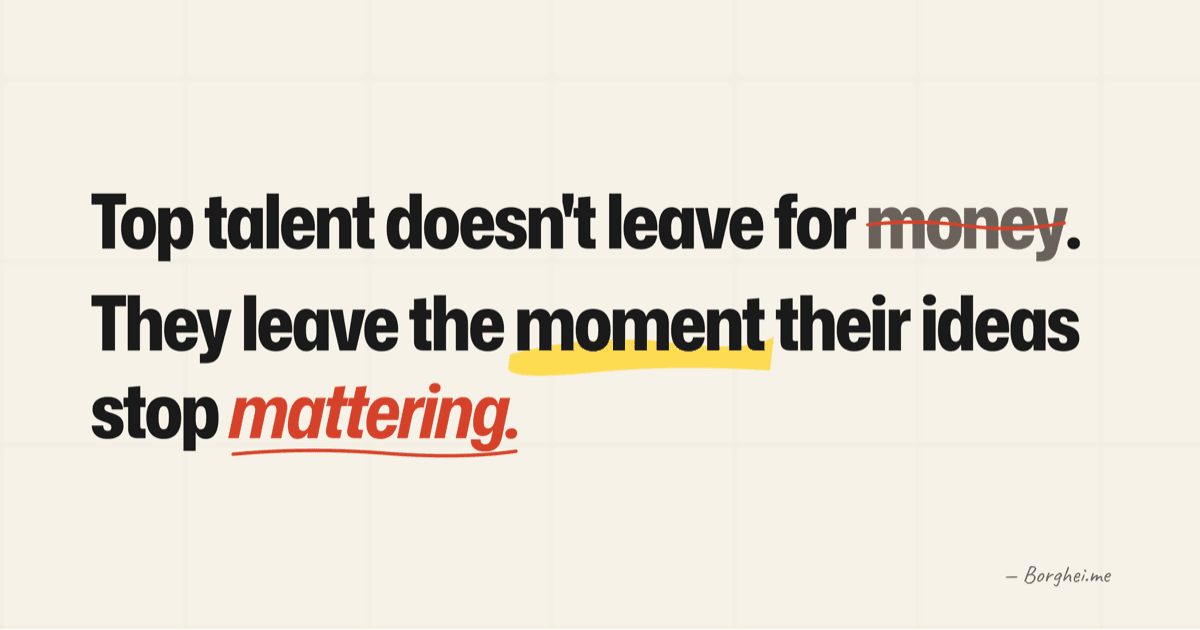
Top talent doesn't quit over pay. They quit when their ideas stop reaching the room. What the data shows, what most leaders miss and what to actually do.
There's a moment in a meeting when the smartest person in the room stops talking.
You can usually see it. Their idea got reframed and assigned upward. Or it was politely heard and quietly dropped. Or, most common, someone with a more senior title said something worse, louder, and the room moved on.
The first time, they shrug. The third time, they recalibrate. By the tenth, they've stopped bringing real ideas to that room. They show up. They ship. They look fine on the engagement survey. And six months later, they leave.
I've watched this play out in companies I've worked with, in conversations with founders trying to reverse-engineer why their best people just quit and in postmortems where everyone is still pointing at compensation as if that's the variable. It almost never is. The pattern is older than any one company and the data behind it is uncomfortably consistent.
The thesis of this piece is simple. Top talent doesn't measure your compensation band. They measure whether their judgment reaches the room. When the answer is no, they don't fight harder. They go quiet. Then they go.
The number isn't pay, it's voice
McKinsey ran a 13,000-person survey across six countries during the Great Attrition and asked people why they'd actually left their last job. Uncaring and uninspiring leaders showed up as a top-three reason for 35% of leavers, alongside lack of career development and inadequate pay. Meaningful work, unsustainable expectations and lack of support followed close behind. Pay is on that list, and in the European cut of the same research it ranks first. But it shares the podium with how people are led, which is not how most retention conversations treat it.
The Gallup data tells the same story from a different angle. Globally, employees who are not engaged or actively disengaged cost the world an estimated $8.8 trillion in lost productivity, roughly 9% of global GDP. In Gallup's 2025 read, global engagement fell back to 21%. And in Gallup's longer-running work on managers, 70% of the variance in team engagement traces directly to the manager. Not the strategy. Not the perks. The manager. And what they do with the ideas in front of them.
The line from Gallup that I keep coming back to is about the majority who sit in the middle. They aren't your worst performers. They're indifferent. They give you their time, but not their best effort and not their best ideas.
That's the cost everyone underprices. It's not the idea you didn't hear today. It's the next ten you'll never get because the person who would have brought them learned, correctly, that bringing them isn't worth it.
This is the pattern beneath the resignation letter. People rarely write "I left because my ideas stopped mattering." They write something about growth, or compensation, or work-life balance. Those are the visible reasons. The invisible reason is upstream: somewhere along the line, the system stopped rewarding their judgment, and they stopped offering it.
Politics is what happens when title beats merit
Every company says the best idea wins. Most companies don't actually run that way. They run on what's easier to defend in the room, which is usually whatever the most senior person said.
Amy Edmondson's research on voice and silence at Harvard makes this concrete. The risks of speaking up are asymmetric. Those lower in the hierarchy carry the downside of reputation damage, relationship strain and career penalties, while having little guarantee that their input will land. The math, from the speaker's seat, is that staying quiet is almost always the safer move. So they stay quiet. And the organization confuses that silence with alignment.
It isn't alignment. It's withdrawal. An unshared improvement idea goes undetected. An unanswered question quietly limits how well the team performs. The cost is invisible because the thing that didn't happen leaves no trace.
Politics, in the operational sense, is just this: a system in which whose-idea matters more than which-idea. The org chart becomes the filter. Ideas don't compete on merit; they compete on the seniority of their carrier. Once that's the filter, three things happen on a predictable timeline.
First, the speed of decisions slows. The right call is often visible to the person closest to the work, but they need three layers of permission to make it. By the time they get it, the moment has passed.
Second, the quality of decisions degrades. Senior people are not always wrong, but they are rarely closer to the data than the team executing. When the data flows up through deference rather than directness, what reaches the top is curated, softened and late.
Third, the high performers leave. This is the one that ends careers. MIT Sloan's research on retention found failure to recognize performance among the strongest predictors of attrition: companies that don't distinguish high performers from laggards in recognition and reward lose the high performers first. The B players will tolerate a politicized environment because they don't have other offers. The A players have a phone full of recruiters. They'll stay through one ignored idea. They won't stay through ten.
A useful test: when was the last time, in your org, that someone three layers down changed a senior leader's mind in a meeting? If you can't think of a recent example, you don't have a meritocracy. You have a hierarchy that markets itself as one.
Autonomy is the architecture, not the perk
The fix isn't a culture deck. It's the way decisions actually get made on a Tuesday afternoon.
Autonomy gets thrown around as a feel-good word, but the operational version is much narrower and much more useful. It's three things: decision rights, resource access and error tolerance. If a person has all three for the work in front of them, they are autonomous. If any one is missing, they aren't, regardless of what their job title says.
MIT Sloan's body of work on this is direct: a year after a company removes layers, its workforce holds a higher share of conscientious, agreeable and open people, and it gets there largely through turnover. Structure changes who stays. The implication runs the other way too. Stack the hierarchy, narrow the decision rights, and you'll select for people who are comfortable being told what to do. The high performers will route around you to a company that gives them the room.
Micromanagement is the most-discussed failure mode here, but it's almost never the explanation a manager gives themselves. They call it "staying close to the work" or "ensuring quality." The signal received by the high performer is the same either way: I don't trust you to make this call. I can't point you at a study that isolates this one, so take it as a pattern rather than a finding. It is the most consistent pattern in this piece all the same: the confidence goes first, then the motivation, then the person.
The harder failure mode, and the one I see more often in practice, is the inverse: leaders who say "you have full ownership" and then quietly override every meaningful decision. This is worse than micromanagement because it adds a credibility tax. The person now knows the autonomy was theater. They stop investing in the decisions because they know the decisions aren't really theirs.
The cleanest version, in my experience, is to give people the problem, the constraints and the deadline. Not the solution. Then get out of the way. When something goes wrong, the question is whether the process was sound, not whether the outcome was the one you would have picked. If the process was sound and the outcome was wrong, that's an expensive lesson the team now owns. If the process was bad, that's a coaching moment. Either way, the autonomy survives the failure. That's the only kind of autonomy that compounds.
Environment design is the work
Everything above points at the same conclusion. Retention of top talent is not a recruiting problem or a compensation problem. It's an environment design problem, and the environment is built decision by decision.
The companies that get this right share a small set of habits, none of which require a culture deck.
Decisions are made by the person closest to the problem who has the context to make them, not the person with the most senior title in the room. When that person makes a call the senior leader disagrees with, the disagreement is a structured conversation, not a reversal. The default state is that the call holds.
Disagreement is treated as data, not as a relationship event. People can say "I think this is wrong" without it being a career-affecting moment. This is what Edmondson and the original Google research on team performance pointed at: psychological safety as the single largest predictor of which teams compound and which ones decay. It is not the absence of conflict. It's the presence of conflict without consequence to the relationship.
The best argument wins. Not the loudest, not the most senior, not the one delivered with the most confidence. Real meritocracies are uncomfortable for senior people because they have to actually be right, not just have the title. Most leaders say they want this. Few of them survive it.
Here's the filter test, the one I run in my head when I'm trying to assess a company's environment in the first month:
Who is the most junior person in this organization who has, in the last 90 days, materially changed a decision that came from a level above them? If the answer is "I can think of three examples," the environment is alive. If the answer is "I'm not sure that's happened," the environment is selecting for compliance, and the high performers are already updating their LinkedIn.
The cost is everyone who came after them
The smart person who stops talking in meetings is the canary, not the cost.
The cost is everyone who came after them. The new hire who watched the senior engineer stop pushing back and concluded, correctly, that pushing back wasn't safe here. The promising PM who saw their roadmap idea get reframed and credited up the chain, and learned to keep the next one to themselves. The team lead who stopped bringing edge cases to the strategy meeting because the strategy was already decided and the meeting was theater.
You don't see those costs on a dashboard. You see them in the quality of the decisions you're making a year later, when the small course-corrections that should have surfaced in week three didn't, and the gap between what you thought was happening and what was happening became too big to close.
Top talent leaves when their ideas stop mattering. That's the variable. Not pay, not perks, not the office, not the title. Whether what they think reaches the room and changes what happens next. That's the entire game.
You can hire the best people in the market. You will not retain them, and you will not benefit from them, if your system filters their judgment out before it reaches the room. Environment design is the work. Everything else is decoration. If you're seeing this pattern in your own org and want to talk it through, get in touch.
Sources
- McKinsey & Company, The Great Attrition is making hiring harder (13,382 respondents across six countries, 2022)
- McKinsey & Company, European talent is ready to walk out the door
- Gallup, Fixing the world's $8.8 trillion problem
- Gallup, Global engagement falls for the second time since 2009
- Gallup, Managers account for 70% of variance in employee engagement
- Harvard Business School, Do I Dare Say Something? on Detert and Edmondson's work on upward voice
- MIT Sloan Management Review, Toxic culture is driving the Great Resignation
- MIT Sloan Management Review, People follow structure: how less hierarchy changes the workforce
- Google re:Work, Understand team effectiveness (Project Aristotle)
This is the first in a weekly series on what I see in the market and hear from operators across the companies I've worked with. Next week: why "alignment" is the most overused word in leadership, and what it usually means when people use it.